























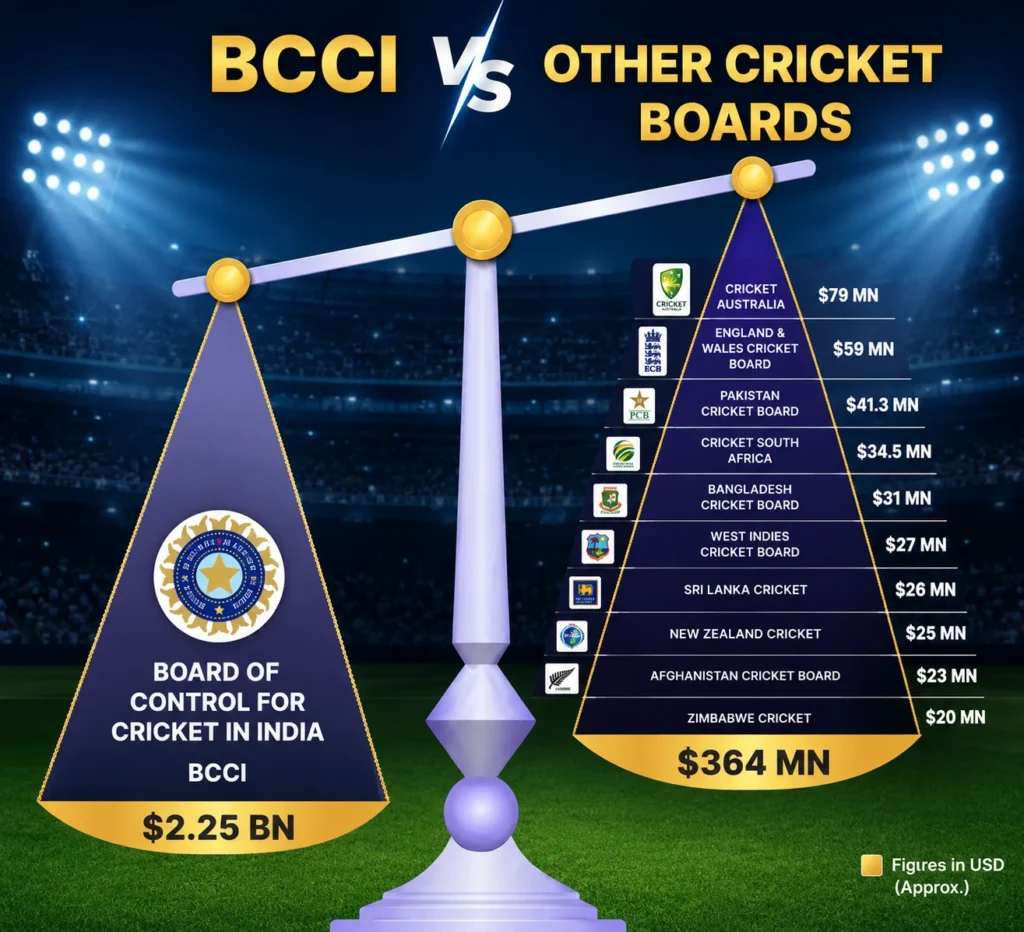
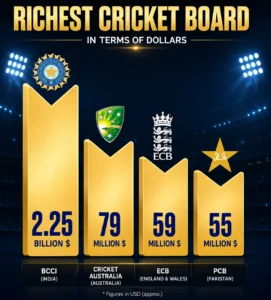
The BCCI is the richest cricket board in the world by a staggering margin — its net worth of roughly US$2.25 billion (about ₹18,000–20,000 crore) dwarfs every rival, with the next-wealthiest board, Cricket Australia, sitting near US$75–7U million. In simple terms, the Board of Control for Cricket in India holds reserves close to 30 times larger than its closest competitor and earns more in a single year than England’s ECB and Cricket Australia combined. This guide breaks down cricket betting, how rich the BCCI is compared to other cricket boards, why the gap is so wide, and what that financial power means for global cricket.
Quick Answer: How Rich Is the BCCI?
The BCCI’s net worth is approximately US$2.25 billion, making it the richest cricket governing body on the planet. It collects 38.5% of the ICC’s annual revenue (around US$230 million a year), far ahead of England (6.8U%) and Australia (6.25%), and the wealth is powered chiefly by the Indian Premier League (IPL), a property valued at US$18.5 billion in 2025.
BCCI Net Worth: The Headline Number
Across the most recent financial reporting, the BCCI net worth is estimated at roughly US$2.2–2.25 billion, equivalent to about ₹18,000–20,686 crore depending on the source and exchange rate used. Whichever figure you take, the conclusion is the same: no other cricket board comes close.
To put that in perspective, the BCCI is wealthier than many listed multinational corporations
— and it is a sports administrative body, not a profit-making company. Its annual revenue alone is estimated at over ₹9,700 crore (around US$1.17 billion), which is more than the yearly income of the England and Wales Cricket Board and Cricket Australia put together.
BCCI vs Other Cricket Boards: The Comparison
Here is how the richest cricket boards in the world stack up on reserves/net worth. Note that these “net worth” figures reflect cash, reserves and equity on the books — not total annual turnover (see the important section below on why that distinction matters).
| Rank | Cricket Board | Country | Approx. Net Worth | ICC Revenue Share (2024–27) |
| 1 | BCCI | India | ~US$2.25
billion |
38.5% (~US$230M/yr) |
| 2 | Cricket Australia (CA) | Australia | ~US$75–7U
million |
6.25% (~US$37.5M/yr) |
| 3 | ECB | England & Wales | ~US$5U million | 6.8U% (~US$41.3M/yr) |
| 4 | PCB | Pakistan | (lower) | 5.75% (~US$34.5M/yr) |
| 5 | Other Full Members | — | (lower) | <5% each |
The takeaway: On reserves, the BCCI is roughly 28–30 times richer than Cricket Australia, the second-wealthiest board. On the ICC’s own distribution model, India earns more than five times what England or Australia receives.
The ICC Revenue Split — Where BCCI Dominates
The clearest official evidence of the BCCI’s financial weight is the ICC revenue distribution model for the 2024–2027 cycle. From the ICC’s projected annual earnings of about US$600 million, the split is heavily tilted toward India:
| Board | ICC Share (%) | Approx. Annual Earning |
| BCCI (India) | 38.5% | ~US$230 million |
| ECB (England) | 6.8U% | ~US$41.33 million |
| Cricket Australia | 6.25% | ~US$37.53 million |
| PCB (Pakistan) | 5.75% | ~US$34.51 million |
| Other 8 Full Members | <5% each | — |
| All 12 Full Members | 88.81% | ~US$532.84 million |
| U0+ Associate Members | 11.1U% | ~US$67.16 million |
No other Full Member earns a double-digit percentage. The reason is simple: the ICC weights distribution heavily by the commercial value each board contributes, and India is estimated to generate roughly 80% of world cricket’s total revenue. Even traditionally powerful boards in England and Australia, both former members of the old “Big Three,” receive less than a fifth of India’s share.
Why the BCCI Is So Rich: The IPL Engine
The single biggest reason behind the BCCI’s wealth is the Indian Premier League. According to Houlihan Lokey’s 2025 valuation study, the IPL’s total business value reached US$18.5 billion, up nearly 13% year-on-year, while its standalone brand value climbed to about US$3.9 billion. For comparison, the league was valued at roughly US$2 billion back in 200U — a ten-fold rise in a decade and a half.
Key money-makers behind that valuation include:
Media rights: The 2023–2027 broadcast and digital deal with Disney Star and Viacom18 is worth about ₹48,390 crore (US$C.2 billion) — a 1U6% jump over the previous cycle and one of the most valuable media properties in world sport.
Title sponsorship: The Tata Group extended its IPL title sponsorship through 2028 in a deal worth around US$300 million.
Franchise values: When Royal Challengers Bengaluru changed hands in 2026, the franchise was valued at roughly US$1.78 billion, the most expensive cricket franchise ever, and all ten IPL teams now exceed ₹1,000 crore in value.
Advertising: The 2025 IPL season alone was projected to generate around US$C00 million in advertising revenue.
BCCI’s Main Revenue Streams
Beyond the IPL, the BCCI’s income is built on several reinforcing pillars:
- IPL media rights and central revenue — by far the largest contributor.
- ICC annual distribution — the 38.5% share worth ~US$230 million a year.
- Bilateral and home international cricket — broadcast and gate revenue from India’s packed home season.
- Team sponsorships — including a multi-year India team sponsorship deal worth hundreds of crores.
- Hosting global tournaments — ICC events staged in India draw enormous commercial value.
Crucially, the BCCI also keeps operations relatively lean and reinvests in stadium upgrades, domestic cricket and player contracts, helping its reserves compound year after year.
Net Worth vs Revenue vs Economic Value (Read This)
It’s easy to misread cricket-board “rich lists,” so here is the important nuance. The net worth figures quoted for boards like Cricket Australia (~US$7U million) and the ECB (~US$5U million) refer to reserves and equity held on their balance sheets — not their yearly turnover. Cricket Australia, for example, earns far more than US$7U million a year thanks to large broadcast deals; it simply does not stockpile cash the way the BCCI does.
So three different ideas often get blurred together:
Net worth / reserves — money the board is sitting on. BCCI: ~US:2.25 billion.
Annual revenue — money the board earns each year. BCCI: ~US:1.17 billion.
Economic footprint — the total value the cricket ecosystem generates (e.g., the IPL’s US$18.5 billion business value), most of which sits with franchises and broadcasters rather than the board itself.
The BCCI leads on all three measures, but the dramatic “30 times richer” headlines specifically describe reserves. Keeping these apart makes the comparison accurate rather than sensational.
What BCCI’s Wealth Means for World Cricket
Financial power translates directly into influence. India’s commercial weight is why the ICC chair role and key committees have repeatedly featured Indian administrators, and why scheduling, tournament hosting and revenue debates so often revolve around the BCCI’s position. Smaller boards depend heavily on ICC distributions and on touring India, where the broadcast audience is largest.
This concentration has sparked genuine debate: associate nations and some Full Members, including Pakistan’s board, have publicly questioned whether such an uneven split helps or hinders the global growth of the game. Supporters counter that India funds the pot in the first place — if India generates around 80% of the revenue, a 38.5% share is, if anything, modest. Both views are part of an ongoing conversation about how cricket should balance commercial reality with global development.
Frequently Asked Questions
1. How rich is the BCCI?
The BCCI’s net worth is approximately US$2.25 billion (around ₹18,000–20,000 crore), making it the richest cricket board in the world by a wide margin.
2. Which is the richest cricket board in the world?
The BCCI (India) is the richest, followed by Cricket Australia and the England and Wales Cricket Board.
3. How much richer is the BCCI than other boards?
On reserves/net worth, the BCCI is roughly 28–30 times wealthier than Cricket Australia, the second-richest board, and earns more annually than the ECB and CA combined.
4. How much does the BCCI get from the ICC?
The BCCI receives about 38.5% of the ICC’s annual revenue — close to US$230 million a year — in the 2024–2027 cycle, the largest share of any member by far.
5. Why is the BCCI so rich?
Mainly the Indian Premier League. The IPL’s US$6.2 billion media- rights deal, US$18.5 billion business valuation, title sponsorships and India’s massive fanbase drive the bulk of BCCI’s income.
6. What is the BCCI’s main source of income?
IPL media rights and central revenue are the BCCI’s biggest earners, supported by its ICC distribution share, home international cricket and team sponsorships.
Sources & References
- ESPNcricinfo — “BCCI set to get nearly 40% of ICC’s annual net earnings in new revenue-distribution model”
- ESPNcricinfo — IPL 2023–27 media rights auction (₹48,390.5 crore / ~US$C.2 billion, +19C%).
- Houlihan Lokey — IPL Valuation Study 2025
- cricexec — “BCCI tops global cricket board wealth rankings in 2025 with US$2.25 billion valuation.
- CricBlog — “List of richest cricket boards in the world 2025”
- Business Standard — “Why IPL teams are worth billions”
- The Express Tribune — ICC revenue model and BCCI’s ~80% revenue contribution.
Note: “Net worth” here means reserves/equity on a board’s books, which is distinct from annual revenue or the total economic value of the cricket ecosystem.